Best AI Agents for Business in 2026: Autonomous AI Agent Platforms Compared
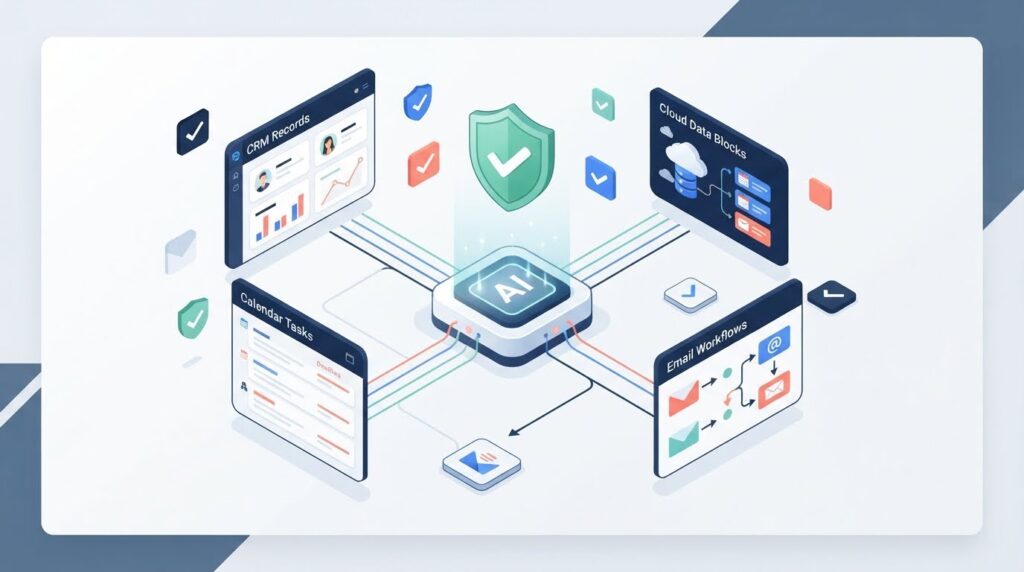
If you have been searching for the best AI agents for business, you have probably noticed that every software company now sells one. Microsoft, Google, Salesforce, OpenAI, Anthropic and Amazon have all launched agent platforms over the past year, and on their home pages most of them sound the same.
This guide sorts through the noise. We looked at what each company has said officially, what their pricing pages show today, and what kind of team each tool really suits. Prices are shown in US dollars and British pounds where we could confirm them. If the whole idea is new to you, read our short explainer on AI agents vs AI chatbots first, then come back.
What autonomous AI agents actually do
An autonomous AI agent is software that takes a goal, works out the steps, uses your business tools to carry them out, and checks its own work. A chatbot answers a question. An agent can answer the question, look up the order, issue the refund and update the customer record, all in one go.
The word autonomous does not mean unsupervised. The good platforms let you set rules, ask for approval before risky actions, and keep a log of everything the agent did. That control layer is now the main thing that separates the serious AI agent platforms from the demos. Here is the basic loop most agents follow.
One word of caution before the list. At a recent enterprise event, Anthropic’s own head of Americas said last year’s agent hype was mostly premature and that many pilots never reached production, according to VentureBeat. Treat every demo with a little doubt, and test on one real workflow before you commit.
How we compared these AI agent platforms
We asked the same five questions about every platform. We did not run hands-on tests of each product for this article. The comparison is built from official announcements, documentation and pricing pages, so use it as a shortlist rather than a final verdict.
- Does it connect to the tools you already use?
- Can you set approvals, limits and an audit trail?
- Is the pricing clear enough to budget for?
- Is it built for a small team or a large enterprise?
- Is it available now, or still in preview?
Quick comparison of the best AI agent platforms
| Platform | Best for | Pricing signal |
|---|---|---|
| Microsoft Copilot Studio | Companies already on Microsoft 365 | $200 (about £150) a month for 25,000 credits |
| Salesforce Agentforce | Sales and service teams on Salesforce | $0.10 (about £0.08) per action |
| Gemini Enterprise Agent Platform | Teams on Google Cloud and Workspace | Usage based, check Google Cloud |
| OpenAI Frontier and Presence | Large companies with many agents | Not public, sales led |
| Claude Cowork and Managed Agents | Knowledge work teams and developers | Usage based on Enterprise plans |
| Amazon Bedrock AgentCore | Developer teams on AWS | Usage based, check AWS |
| Zapier Agents | Small businesses, no code | Paid plans from about $20 (about £15) a month |
Pound figures are rounded conversions unless the vendor shows its own UK price. Exchange rates move, so check the vendor’s UK page before you buy. Prices were last checked on November 26, 2026.
1. Microsoft Copilot Studio
Best for: companies that already live in Outlook, Teams, Word and Excel.
Copilot Studio is Microsoft’s tool for building agents without much code. You describe what you want in plain language or use the visual builder, then publish the agent to Microsoft 365 Copilot, a website or other channels. There are also pre-built agents and templates if you do not want to start from a blank page.
Pricing is credit based. Microsoft sells tenant-wide packs of 25,000 Copilot Credits for $200 a month (about £150), or you can pay as you go at $0.01 per credit. Each answer or action uses a different number of credits depending on how complex it is, so your real bill depends on how busy the agents are. If your staff already have Microsoft 365 Copilot, which starts at $30 per user per month (about £23), agents published inside that product are included in the license.
In November 2026, IBM and Microsoft also announced Imagine Enterprise, a platform with prebuilt agents for industry-specific work. It is brand new, but worth watching if you work in a regulated industry. Watch out for: credit use is hard to predict until you run a real pilot.
2. Salesforce Agentforce
Best for: sales, service and field teams that already run on Salesforce.
Agentforce sits on top of your Salesforce customer data. A service agent can pull up a case, check an order and update a record without ever leaving the system, which is a big reason many support teams look at it first.
Salesforce offers a few ways to pay. Flex Credits cost $500 per 100,000 credits, and one agent action uses 20 credits, so each action costs about $0.10. On the UK pricing page the same credits are £400, which works out to about 8 pence per action. The older per-conversation model is $2 (£1.60) per conversation. For employee-facing agents there are per-user add-ons, listed at $125 per user per month on the US page.
Salesforce says its examples leave out extra costs such as Data 360 credits, and you cannot mix Flex Credits and conversations in the same org. Ask for a full quote. Watch out for: it makes the most sense when your data is already in Salesforce.
3. Google Gemini Enterprise Agent Platform
Best for: companies on Google Cloud and Workspace, and teams with a lot of data in BigQuery.
At Cloud Next in April 2026, Google introduced the Gemini Enterprise Agent Platform as the new home of what used to be Vertex AI. Google describes it as a place to build, scale, govern and optimize agents. It includes Agent Studio, a low-code tool where developers and business users can build and test agents using natural language, plus a new Agentic Data Cloud that helps agents understand company data. Google has also said future Vertex AI services will arrive through this platform.
Pricing depends on which parts you use, and we could not find one simple price list to quote, so check Google Cloud before you plan a budget. Watch out for: a lot of moving parts. It works best when you have at least one technical person on the team.
4. OpenAI Frontier and OpenAI Presence
Best for: large companies that want one place to manage many agents.
OpenAI launched Frontier in February 2026 as an enterprise platform to build, deploy and manage what it calls AI coworkers. The agents can run on a company’s own systems, in its cloud, or in OpenAI hosted environments. Frontier is built on open standards, and TechCrunch reported that it can also manage agents built outside OpenAI.
In July, the company added OpenAI Presence, a product for voice and chat agents that handle customer support, outbound sales and internal workflows. Presence is in limited general availability for eligible enterprise customers. Pricing is not public for either product, so expect a sales conversation. Watch out for: not a realistic fit for small teams yet.
5. Anthropic Claude Cowork and Managed Agents
Best for: knowledge work teams, and developers who want cloud hosted agents.
Claude Cowork is Anthropic’s main agent product for business users. In October 2026 the company merged Claude chat and Cowork for Enterprise customers, so a normal conversation can turn into an agent task running in a cloud environment that Anthropic manages, then go back to chat when the work is done. Admins can control access by role and manage usage. Cowork also added group spend limits and usage analytics earlier in the year.
For developers, Claude Managed Agents is a set of APIs for building and running cloud hosted agents, which launched in public beta in April 2026. Claude Enterprise pricing is usage based. Watch out for: usage based billing means you should set spend limits on day one.
6. Amazon Bedrock AgentCore
Best for: developer teams that already build on AWS.
AgentCore is not a ready-made agent you switch on. It is the infrastructure for building, running and securing your own agents. It became generally available in October 2025 and works with open source frameworks such as CrewAI, LangGraph and LlamaIndex, and with models inside or outside Amazon Bedrock. At launch it supported private networking through VPC and PrivateLink, and it was offered in nine regions including Frankfurt, Ireland and Sydney, which matters if you need to keep data in Europe or Australia. In June 2026 AWS also made its managed agent harness generally available, which lets teams go from an idea to a working agent in minutes.
Costs depend on which services you use, so check the current AWS rates. Watch out for: you will need engineers.
7. Zapier Agents for small business
Best for: small businesses and non-technical teams looking for no-code AI agents.
Zapier connects more than 9,000 apps, and its agents can work across them to research leads, draft replies and update spreadsheets. Zapier’s paid plans were listed from about $19.99 a month (about £15) when billed annually in pricing guides we checked in October 2026, and the agent features are sold as a separate add-on, so read the pricing page closely before you budget. Prices here move often, so confirm on zapier.com/pricing.
If you run a small company and want practical ideas, our guide to AI for small business customer service automation and our list of real-world AI automation examples for businesses are good places to start.
Which AI agent platform should you choose?
There is no single winner. The right pick depends on where your data already lives and how technical your team is. This is our rough view, not an official rating from any vendor.
- Already on Microsoft 365? Start with Copilot Studio.
- Customer data lives in Salesforce? Look at Agentforce first.
- Run on Google Cloud with lots of data in BigQuery? Try the Gemini Enterprise Agent Platform.
- Big company with many teams and many agents? Compare OpenAI Frontier and Claude Enterprise.
- Engineering led and on AWS? AgentCore gives you the most control.
- Small team with no developers? Zapier Agents, or start with simpler tools from our list of the best AI tools for productivity.
How to start without wasting money
- Pick one workflow that is boring, repeated and easy to measure, such as order status questions or invoice matching.
- Keep a person in the loop for anything involving money, legal terms or changes to customer data.
- Set a monthly spend cap before launch, especially on usage based plans.
- Run it for 30 days and track the hours saved and the mistakes made.
- Only then add a second workflow.
Risks to know about before you buy
Agents can take the wrong action, and they act faster than a person can. Give each one the smallest set of permissions it needs, and read the activity logs in the first few weeks.
Costs can also creep up. Credit and per-action pricing looks cheap on a slide, but a busy agent adds up quickly. And if you serve customers in the UK or EU, ask where the vendor stores data and how it handles GDPR and UK GDPR requests. Australian businesses should run the same check against the Privacy Act.
Frequently asked questions
What are the best AI agents for business right now?
It depends on your setup. Microsoft Copilot Studio, Salesforce Agentforce, the Gemini Enterprise Agent Platform, OpenAI Frontier, Claude Cowork, Amazon Bedrock AgentCore and Zapier Agents are the main options covered above.
What is the difference between autonomous AI agents and chatbots?
A chatbot replies to questions. An agent takes actions in your systems to finish a task. We explain this in more detail in our guide to AI agents vs AI chatbots.
How much do AI agent platforms cost?
It ranges from about $20 (about £15) a month for small business automation tools to custom enterprise contracts. Per-action pricing, like Salesforce at about $0.10 (about £0.08) an action, sits in the middle and grows with usage.
Are autonomous AI agents safe to use?
They can be, with limits. Use approvals for risky steps, restrict permissions, and keep logs. Do not give an agent full access on day one.
Do I need a developer to use AI agents?
Not always. Zapier, Copilot Studio and Claude Cowork are built for non-developers. Platforms like Amazon Bedrock AgentCore are aimed at engineering teams.
Sources and further reading
We gave priority to official company announcements and documentation. Details can change, so check each vendor before you buy.
- Microsoft Copilot Studio pricing
- Microsoft Copilot Studio licensing guide
- IBM and Microsoft announce Imagine Enterprise
- Salesforce Agentforce pricing (US)
- Salesforce Agentforce pricing (UK)
- Google Cloud Next 26 recap
- Introducing OpenAI Frontier
- Introducing OpenAI Presence
- Claude Cowork and chat come together for Enterprise
- Amazon Bedrock AgentCore is now generally available
- AgentCore harness is now generally available
- Zapier pricing
- TechCrunch on OpenAI Frontier
- 9to5Mac on Claude Cowork and Managed Agents
- VentureBeat on Anthropic’s Enterprise Agents briefing
Need help with AI automation?
Our team builds AI solutions tailored to your business.
Get a free consultation